Don't expect amazing writing here. I'm not editing this beyond correcting my spelling as I go, this is something that has to be written, has to be written down raw.
So, for those who know me, or read my blog (All some of you), you may remember that I have depression. It's not severe. At least, I thought it wasn't. And maybe it still isn't. I just don't know for sure. There's only one thing I know for sure:
Today, the dam broke. Just a little, but enough that I was getting strange looks, because it was pretty plain to see on my face. It happened just over ten minutes ago. I'd just finished posting a series of old vignettes I'd written, based on characters from tabletop sessions (And some who, sadly, never reached a table to have their tales grow, like Finlay Houlihan, the Irish Hunter, or Saint Nicky, the Demon of the Spring Court)... And, just before I left the house, I tweeted that I had to sort the electricity...
...Which is when I started crying. Not full on tears, and it still isn't full on tears, bawling, tearing of the hair, that sort of thing. But it's pretty obvious that my many masks had slipped, and even as I'm writing this, I have to pause for a moment and take a deep breath, close my eyes.
But not to fight back the tears. Because, for the first time, perhaps in a long time, these tears are healthy. I want you to understand that. I need you to understand that. Because a big part of depression is locking your heart away, a little piece at a time, so that you don't do this anymore.
It's not the done thing.
You just need to man up.
What do you have to feel bad about?
Right now, as I'm writing this down (You'll see why it has to be written down soon, I hope), I know what I have to feel bad about. I've reminded myself, and opened a door I closed on myself some time ago.
I have songs, but I only sing them to amuse close friends, people I trust. I locked away those songs, because they're not the done thing.
I have stories, so many stories, so many dreams, and I locked most of them away, treated them almost clinically, because technique, writer, technique, you'll never get good if you don't master technique before flair, or feeling.
I have love to give, so much love, and nobody seems to want it. There are friends, family who accept it, and I love them dearly for the kindness they pay (And it is a kindness, for they know as well as I how valuable a gift it is to give)... But as much as I love them, I am too far away from most to share this love, and perhaps I've not found love in recent years because I don't want to show someone how much I want to hold them, kiss them, caress them, because if you do that right off the bat, no matter how passionate a person you really are, that's creepy, what a creeper, what a freak.
Even knowing that some of these things are exaggerations, my mind magnifying the pain, the fear, the loathing, I know they're also true, at least to some extent. We fear close contact. We're told not to sing, to show joy, after a certain age. We're told that having our own look is unfashionable, or dressing like a douche, or asked why would you want to look different? Answer? Because we want to show people more than one aspect of ourselves, or we want to change ourselves for the better, reach the ideals we know exist, or we just do it to have fun.
The dam's closing up a little now, but I want you to know that, for all that this has sounded like a bad thing, that dam is holding something back that should be in the light, plain for all to see. I shouldn't feel the need to hide it.
I have songs, but I do not sing.
I have words, but I concentrate on meaning, on interest, rather than the raw emotion.
I have love, but I do not express the passion in my soul.
This short (and it is short) outpouring of pain and grief and loss and a million other things that have quietly reverberated through my mind and my heart? For one terrible, awe inspiring, and blackly beautiful moment, they came out. You may think "Oh my god, he's in terrible pain" or "Such a god-damn drama queen!", but the fact is... They've been there. They've been there for a long time... And it is not healthy for them to hide so well.
Today, the dam broke. Just a little. And though folks inexperienced with depression won't think this, that is a healthy thing to have happened. Even if I am crying a little, I'm more worried that the tears are drying up than that they started.
Monday, 8 December 2014

Friday, 28 November 2014
Many Masks.
I thought I'd write this down to give you some idea of... Well, not the "Real Me", for reasons which will become clear. But to help you understand me a little better. Not a lot better, that involves actually getting to know me. But I know there are some folks who seem interested in the writer, rather than the writings out there, so let's start with a statement that seems obvious, or nonsensical, but is very important.
I am, like you, a person of many facets. I wear many masks, many hats. The only real constants are that all of them, at some point or another, will talk about the same things.
One mask is the Big Bad Wolf. I acknowledge that I have a sensual side, that it's always, on some level, hungering for new tastes, new bodies to explore, new thrills and sights and sounds and moans and - I acknowledge that if I was always the Big Bad Wolf, I'd be a sorry individual indeed, nothing more than a rutting beast. So I'm not always the Big Bad Wolf.
Another is that of Mummy Jamie. I worry about my friends, I want to help them, care about them enough to want to care for them. But Mummy Jamie doesn't mind banging heads together, can be a bit of a shrew and a worrywart, and is, on the whole, a somewhat prudish individual. So I'm not always Mummy Jamie.
I'm the Mad Welshman. Why am I mad? Because very few people seem to understand me. They've even told me so to my face. Family members among them, no less! Madness can be a creative force, but it can be isolating. And, in the end, I might not be so mad after all, as, to quote Larry Niven's somewhat conservative Puppeteers, "The majority is always sane, Louis" (A statement that sanity is always judged as a relative matter.) So whether I'm always the Mad Welshman or not, I'm not always seen that way.
I'm the Mystic, my head in other worlds, rather than this one. I know things you don't, but it's very possible they don't apply to normal, everyday concerns, or even reality. What is reality, anyway?
I'm the Noble, I'm the Grump, I'm the Clown and the Wise Man. All of these are masks I wear, and not all of them have what you would call a "Human" perspective on the world. The Thinker calmly goes through logical scenarios, not caring that they're things like "How a terrorist could actually be effective, instead of randomly bombing yahoos" or "How many people it would take to destroy the Internet". And you may get the impression, reading this, that I have some sort of dissociative personality disorder, but no. These are all facets of the complete me.
I'm complicated, and yet simple. And I love it. Talk to me sometime, you might find you have a lot of masks too!
Monday, 24 November 2014
Experimenting with Genre: The Graphical Parser Games
Everyone who knows gaming knows that Text Adventures (or, as many know them now, Interactive Fiction) are a thing, and that Point n Click Adventures came afterward. What not so many know is that there was a middle ground that got explored quite heavily from the late 80s to the mid 90s: The Graphical Parser Games.
Why call them that instead of Graphical Adventure or the like? Because, as I noted, they're an in-between point. They had text adventure style inputs (and later early Point n Click interfaces), or collections of parser you could click on, and graphics. Here, let me show you an early example: Shadowgate. Notice the differences between that and, say, Maniac Mansion (released between this game, and the Atari STE game I'll mention next, in 1987)

While it's not the earliest example (that would be Deja Vu: A Nightmare Comes True, by the same company, ICOM Simulations), you can see many of the features of the prototypical graphic parse- What? You think it's an RPG? No, 'fraid not. There are no HP in this game, just a series of "You did the wrong thing and died horribly." No, really, there's a lot of that in this damn game. Going into the wrong door at the wrong time could kill you!
But we're not here to talk about the foibles of earlier designers, who often conflated "Dick move" with "Challenge" and "Replayability" because they didn't know better... So let's see... We have an EXITS doohickey we can click in the bottom left (useful, because often we can't look around), A set of verbs, an inventory, a self button, spells, and... Wait, what do we click on?
Ah, here's the "beauty" of these experiments. The items are actually on screen, and that's what you click! Shadowgate, as one of the earliest, actually suffered for this. Good example, under this carpet, or one very much like it, there is an item. The only way to tell this item is even there (and you need it) is to pixel hunt. What's that? Well, nowadays, most of the irritation is finding a small area you can click on to do a thing, mostly because of glitchy context sensitive controls in the games that have those. In older games, with a smaller screen size (Go look up EGA limits to get some idea of how big this would have been, at its best... Or perhaps CGA, for extra magenta funtimes!), the thing you could click on could be as small as... A single pixel. In among, at the time, anything up to 307,200 on the screen (or less, like Shadowgate)
Now you know why I'm a grouchy old sod about games sometimes... Because I grew up with this shit.
In any case, Shadowgate didn't have a great story, but other experiments happened around the same time as ICON's games. Here's Wonderland, as you would see it on an Atari ST.

Pretty neat, huh? No? Well, consider that, at the time the Atari STE came out, you had... Er... GEM. Not even Windows 3.1. Fucking GEM. And these windows you're seeing? They aren't the Atari ST's Little Green Desktop (AKA Crystal, the precursor to GEM), they're a system that's part of the game itself. And all of these windows are resizable, movable, and can be closed out if need be. Of course, not every system got something this sweet. Here's Guild of Thieves on the C64.

Not as cool, is it? In fact, apart from the well drawn pixel art (considering the limitations of the system), it's no different from, say... Twin Kingdom Valley, or Questprobe's Marvel graphical text adventures... Where, on most platforms they came out on, you had to specifically request the drawing, and it would look... Well...

...About like that. But like their ICON contemporaries, the Magnetic Scrolls adventure games had a selectable parser. You could, if you were somehow in possession of an Atari ST without a working keyboard (Not completely uncommon, but relatively easy to fix), you could click on a VERB or COMMAND menu, then something either in the room, or in your inventory. It had separate windows for both, with pretty icons. In this way, the Magnetic Scrolls games beat the metaphorical tar out of their compatriots. So let's look at the final compatriot, which did one thing both ICON and the Magnetic Scrolls games didn't quite manage.
Legend Entertainment released their first game in 1990. It was... Er...

...This, Spellcasting 101. If you guessed from this screenshot that the series (for lo, they made three of them!) was on par, writing and tone wise, with Leisure Suit Larry... You'd be quite right. But, regardless of my opinion of the game (Slightly embarassed it exists, thanks for asking), it nonetheless belongs to the subgenre, and Legend (With chief writer and ex-Infocom staffer Steve Meretzky at the helm most of the company's life) went on to better things. Mostly better, anyhoo. Fast forward two years, and you have their first tie-in (A thing they became famous for) ...

...Frederik Pohl's Gateway. Based on the science fiction series of the same name (And, not oddly at all, the same author), the game was... Actually critically lambasted for feeling out of date, design wise. But suffice to say, it now has quite a cult following, as do Legend in general and Steve Meretzky. Sadly, the sequel to this game (also panned) was the last gasp of the subgenre in the mainstream, and after this, Legend went on to make first person graphical adventure games, with the mostly familiar elements you'd expect. And so history trundled on. But Legend pretty much thrived in this field, whereas ICON and the MS team... Didn't really.

Why call them that instead of Graphical Adventure or the like? Because, as I noted, they're an in-between point. They had text adventure style inputs (and later early Point n Click interfaces), or collections of parser you could click on, and graphics. Here, let me show you an early example: Shadowgate. Notice the differences between that and, say, Maniac Mansion (released between this game, and the Atari STE game I'll mention next, in 1987)

Hit self: You die. Open door: You die.
While it's not the earliest example (that would be Deja Vu: A Nightmare Comes True, by the same company, ICOM Simulations), you can see many of the features of the prototypical graphic parse- What? You think it's an RPG? No, 'fraid not. There are no HP in this game, just a series of "You did the wrong thing and died horribly." No, really, there's a lot of that in this damn game. Going into the wrong door at the wrong time could kill you!
But we're not here to talk about the foibles of earlier designers, who often conflated "Dick move" with "Challenge" and "Replayability" because they didn't know better... So let's see... We have an EXITS doohickey we can click in the bottom left (useful, because often we can't look around), A set of verbs, an inventory, a self button, spells, and... Wait, what do we click on?
Ah, here's the "beauty" of these experiments. The items are actually on screen, and that's what you click! Shadowgate, as one of the earliest, actually suffered for this. Good example, under this carpet, or one very much like it, there is an item. The only way to tell this item is even there (and you need it) is to pixel hunt. What's that? Well, nowadays, most of the irritation is finding a small area you can click on to do a thing, mostly because of glitchy context sensitive controls in the games that have those. In older games, with a smaller screen size (Go look up EGA limits to get some idea of how big this would have been, at its best... Or perhaps CGA, for extra magenta funtimes!), the thing you could click on could be as small as... A single pixel. In among, at the time, anything up to 307,200 on the screen (or less, like Shadowgate)
Now you know why I'm a grouchy old sod about games sometimes... Because I grew up with this shit.
In any case, Shadowgate didn't have a great story, but other experiments happened around the same time as ICON's games. Here's Wonderland, as you would see it on an Atari ST.
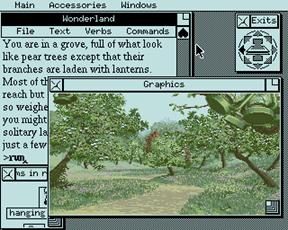
And this screen, like others in the series, was ANIMATED too!
Pretty neat, huh? No? Well, consider that, at the time the Atari STE came out, you had... Er... GEM. Not even Windows 3.1. Fucking GEM. And these windows you're seeing? They aren't the Atari ST's Little Green Desktop (AKA Crystal, the precursor to GEM), they're a system that's part of the game itself. And all of these windows are resizable, movable, and can be closed out if need be. Of course, not every system got something this sweet. Here's Guild of Thieves on the C64.
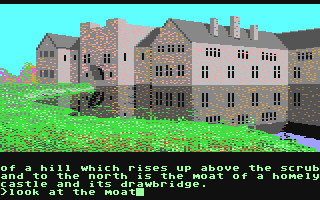
Nary a window to be seen.
Not as cool, is it? In fact, apart from the well drawn pixel art (considering the limitations of the system), it's no different from, say... Twin Kingdom Valley, or Questprobe's Marvel graphical text adventures... Where, on most platforms they came out on, you had to specifically request the drawing, and it would look... Well...

You see a cabin in the woods. It is where you put treasure.
...About like that. But like their ICON contemporaries, the Magnetic Scrolls adventure games had a selectable parser. You could, if you were somehow in possession of an Atari ST without a working keyboard (Not completely uncommon, but relatively easy to fix), you could click on a VERB or COMMAND menu, then something either in the room, or in your inventory. It had separate windows for both, with pretty icons. In this way, the Magnetic Scrolls games beat the metaphorical tar out of their compatriots. So let's look at the final compatriot, which did one thing both ICON and the Magnetic Scrolls games didn't quite manage.
Legend Entertainment released their first game in 1990. It was... Er...
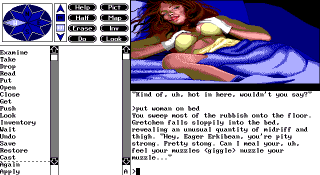
Hoo, boy... This is awkward.
...This, Spellcasting 101. If you guessed from this screenshot that the series (for lo, they made three of them!) was on par, writing and tone wise, with Leisure Suit Larry... You'd be quite right. But, regardless of my opinion of the game (Slightly embarassed it exists, thanks for asking), it nonetheless belongs to the subgenre, and Legend (With chief writer and ex-Infocom staffer Steve Meretzky at the helm most of the company's life) went on to better things. Mostly better, anyhoo. Fast forward two years, and you have their first tie-in (A thing they became famous for) ...
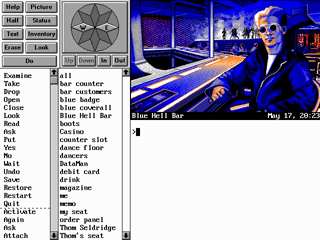
Know what impresses me? That item list!
...Frederik Pohl's Gateway. Based on the science fiction series of the same name (And, not oddly at all, the same author), the game was... Actually critically lambasted for feeling out of date, design wise. But suffice to say, it now has quite a cult following, as do Legend in general and Steve Meretzky. Sadly, the sequel to this game (also panned) was the last gasp of the subgenre in the mainstream, and after this, Legend went on to make first person graphical adventure games, with the mostly familiar elements you'd expect. And so history trundled on. But Legend pretty much thrived in this field, whereas ICON and the MS team... Didn't really.
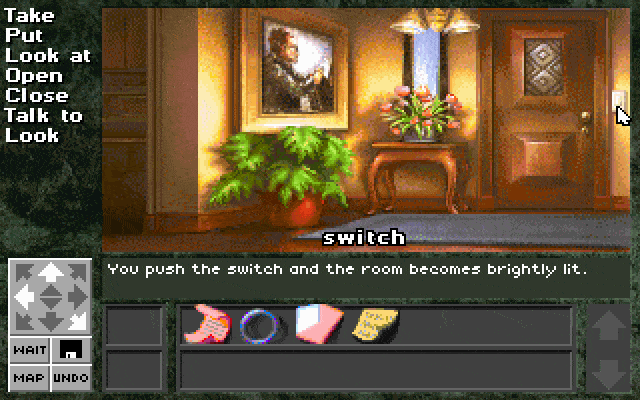
Companions of Xanth: Not Legend's greatest achievement. That would be Callahan's Crosstime Saloon.
Wednesday, 5 November 2014
Experimenting with the Genre: "Failed" Boulderdash Games
Sometimes, experiments in a genre are missed, or aren't appreciated. I thought I'd start, in my usual "When it occurs to me" way, to take a brief look at various experiments in gaming history, starting with four "Boulderdash Clones" that were released on the BBC Micro over its shelf life: Repton Infinity, Bonecruncher, Clogger, and XOR. XOR, as we'll see, only tentatively fits this category, but some of you, no doubt, are scratching your heads and saying "Er... Bold-Her-Dash?"
Let me explain. This here, in the screenshot below, is a typical Boulderdash screen:

Now, there's quite a few things missing on this screen, but three of the absolute basic elements are here: Your hero (named Rockford), who must collect all the diamonds/eggs/whatever the hell thing he's collecting today (Believe me, it varies, but most often it's diamonds, because diamonds were easy to draw on an 8 bit game), while not getting trapped or crushed by rocks (which follow certain rules you can abuse, and later have to abuse), or killed by monsters and fungus. You also have a time limit in each level, which can, in some versions and clones, be reset or added to with a collectible. A nice, simple formula that spawned... Metric fucktons of clones.
But not every game was a lazy clone, and, while all four of the games I'm now going to talk about were moderately popular at the time, they've been relegated to the sidelines of gaming history, for the most part.
First up is Repton Infinity (1988, Superior Software). Repton was the BBC equivalent of Boulderdash, a green lizard man (Rockford's apparently human) who had three main games, a couple of standalone expansions, and Infinity. Infinity was, at its most basic level, a "Make your own Repton", and at first, it doesn't look much more fun to play with, or more powerful, than Boulderdash Construction Kit (released two years earlier than Infinity, in 1986)
But then you actually get into the thing, and you realise (mainly from the demo levels provided) that you can change the rules. Not many of them, but the templates provided allowed for more mechanics than had previously existed across the whole series. Below is one example of the modified rule and tilesets... The worst of the three.

Meet Robbo. Robbo, like Repton, has to collect... Things. But he has different obstacles, and they act somewhat differently to the way they would in the main Repton games: Instead of keys (Which open all diamond-holding safes), he has a computer disk... Which he has to actually put in a computer. There are things he has to hit with a wrench to make them work again. And there are things that don't fall the way you thought they would if you played much Boulderdash or Repton.
The Robbo levels were annoying as hell, but they opened up the game to ever so slightly more than just "I recolour Rockford to be Red, and make maps". I respect that. So, moving on...

Bonecruncher, also from Superior (I'm not promising, but there might be a pattern here), also experimented. It also had resources to collect, and if you could guess from the cover that it involved bones somehow, you'd win yourself an imaginary cookie: Bono, our hero, is the proud owner of a business selling soap to the monsters that surround his island castle. For reasons best left unexplored (IE - Because it's a puzzle game that wasn't actually worried about plot except as a framing device), monster soap is made from very human skeletons strewn around the castle (5 per bar of soap), and winning the level does not, in many cases, require you to grab them all... Just enough to make soap for monsters. Let's take a brief poke at a Bonecruncher screen.

Okay, we've got most of the game's puzzle elements on this screen, good enough (Thanks Wikipedia). Skeletons for soap: Check. Keys for doors: Check. Thing that could be a monster, but is actually your co-worker Fozzy: Check. Eggsiwhotsit that's probably a boulder: Check. But apart from Fozzy, this doesn't seem that different, does it?
Except... That arrow, and the unpictured elements, are what make this one unique. And challenging. See, even though it looks like it's side-view, it's meant to be a top-down look at a floor of Bono's Castle (Just assume I made a St. Bono U2 joke, to save us both some pain), and those eggsiwhotsits (Glooks) don't fall... But they do stampede in the direction of the most recently soaped-up monster. So, let's break down how this is more complex.
Clogger, again, is a different beast.

Clogger is a strange one. Again, the "plot" is only a framework, but collecting things (Apples, in this case) is only half the fun! There was, as an aside, a sort of unwritten rule back then that a game had to have a plot. I've already written about how you don't need plot in a game, and that sometimes it's a waste of time here , and early game devs don't get a pass for this, even if the knowledge wasn't easily disseminated.
Anyhoo, what made this game different? Screenshots don't really tell the whole story, but the two main goals are as follows:

XOR, like the other games in this article, including Repton and Boulderdash, was about finding your way through a maze, collecting all the things, and reaching the exit. But, unlike pretty much every other game in this post, it didn't have a time limit. It didn't need one, because it was a game where failure was really easy. Let's do our best to sum up how it differed from its compatriots. Screenshot, maestro?

What's pictured are a few of the main elements: Masks, wot you pick up. Map segments, which show where masks are (but not you, or those wibbly bits), and wibbly forcefields that, depending on the way they point, either block vertical (pointing horizontal) or horizontal (vice versa) movement through them, but get destroyed when you move through them the right way. Also, that shield is us.
Not pictured is the other shield, which is also us (We can switch between them), chickens that always fall down (and can kill you if they fall on you), fish that move sideways (and again, kill you if they hit you from more than one tile away), and these four elements provide the majority of the challenge of XOR. It's all about "How do I get all these masks without dying or getting into a Dead Man Walking scenario?" , and I think the developer was very nice (compared to peers of his time) to not give a time limit for thinking about these things (also a password system and the ability to restart a level. Say "Thank you" !)
If you'd bought the game back in the day, you'd also have been asked by the dev to try and complete the game in a minimum number of moves, for a shiny certificate (Devs liked giving out certificates and letters back then, and I'm sure those who still have their shiny certificates are happy, despite the death-stares child me is throwing them from the ether to this day.) It doesn't look fun, but... Actually, if you like logic puzzles, it straddles that fine line between dickish and engaging with aplomb.
Now, at this point in the post, I imagine some people are expecting some sort of moral, or message beyond "Hey, look at these interesting past experiments in a genre mostly made of the same game, but with different maps for ten years!"
There isn't one. I can't say whether the devs got rewarded for their experimentation, or at least felt they did. I don't think it provides anything clear on the old "Tired Sequel XVIII: The Sequeling versus The New (And Possibly Bad) Hotness" argument (Which is a purely opinion style ballyhoo anyhow.) I don't even think all of them are good (I hate Repton Infinity, for example.) But I do think there's some value in looking at these experiments if you're into game development, seeing how changes to a formula can and can't work in a game. Hell, I think that's a good learning experience overall, for any dev, reviewer, or gamer who wants to know what makes this fucking thing tick. So yeah, they're easily found and played, so give them a shot, see what you think of them, and the changes they made to a formula that, honestly, started boring the tits off me somewhere around 1989.
Let me explain. This here, in the screenshot below, is a typical Boulderdash screen:
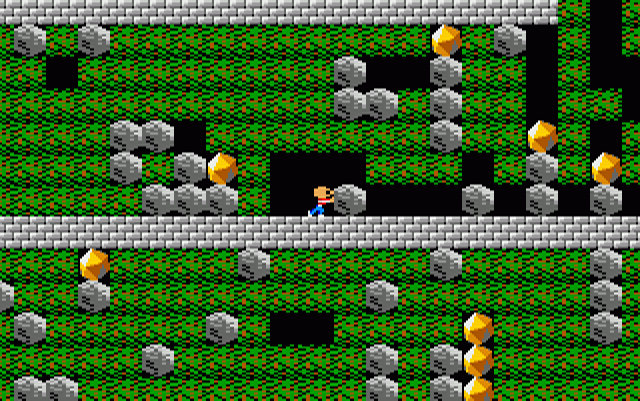
Boulderdash (The Amiga Version) - Prettier than the original 8-bit versions.
Now, there's quite a few things missing on this screen, but three of the absolute basic elements are here: Your hero (named Rockford), who must collect all the diamonds/eggs/whatever the hell thing he's collecting today (Believe me, it varies, but most often it's diamonds, because diamonds were easy to draw on an 8 bit game), while not getting trapped or crushed by rocks (which follow certain rules you can abuse, and later have to abuse), or killed by monsters and fungus. You also have a time limit in each level, which can, in some versions and clones, be reset or added to with a collectible. A nice, simple formula that spawned... Metric fucktons of clones.
But not every game was a lazy clone, and, while all four of the games I'm now going to talk about were moderately popular at the time, they've been relegated to the sidelines of gaming history, for the most part.
First up is Repton Infinity (1988, Superior Software). Repton was the BBC equivalent of Boulderdash, a green lizard man (Rockford's apparently human) who had three main games, a couple of standalone expansions, and Infinity. Infinity was, at its most basic level, a "Make your own Repton", and at first, it doesn't look much more fun to play with, or more powerful, than Boulderdash Construction Kit (released two years earlier than Infinity, in 1986)
But then you actually get into the thing, and you realise (mainly from the demo levels provided) that you can change the rules. Not many of them, but the templates provided allowed for more mechanics than had previously existed across the whole series. Below is one example of the modified rule and tilesets... The worst of the three.
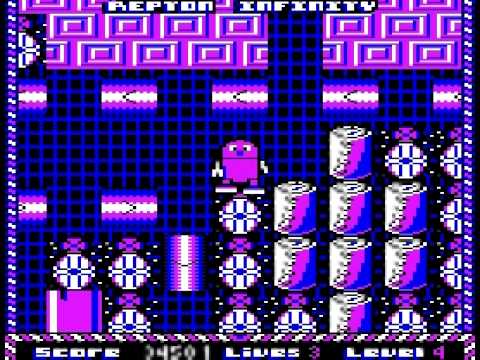
Robbo Doesn't Want to Be Here.
Meet Robbo. Robbo, like Repton, has to collect... Things. But he has different obstacles, and they act somewhat differently to the way they would in the main Repton games: Instead of keys (Which open all diamond-holding safes), he has a computer disk... Which he has to actually put in a computer. There are things he has to hit with a wrench to make them work again. And there are things that don't fall the way you thought they would if you played much Boulderdash or Repton.
The Robbo levels were annoying as hell, but they opened up the game to ever so slightly more than just "I recolour Rockford to be Red, and make maps". I respect that. So, moving on...
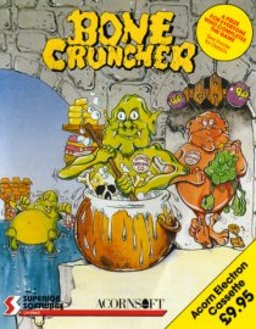
Bonecruncher, also from Superior (I'm not promising, but there might be a pattern here), also experimented. It also had resources to collect, and if you could guess from the cover that it involved bones somehow, you'd win yourself an imaginary cookie: Bono, our hero, is the proud owner of a business selling soap to the monsters that surround his island castle. For reasons best left unexplored (IE - Because it's a puzzle game that wasn't actually worried about plot except as a framing device), monster soap is made from very human skeletons strewn around the castle (5 per bar of soap), and winning the level does not, in many cases, require you to grab them all... Just enough to make soap for monsters. Let's take a brief poke at a Bonecruncher screen.

Ahh, the only unhappy folks are Bono and that eggsiwhotsit.
Okay, we've got most of the game's puzzle elements on this screen, good enough (Thanks Wikipedia). Skeletons for soap: Check. Keys for doors: Check. Thing that could be a monster, but is actually your co-worker Fozzy: Check. Eggsiwhotsit that's probably a boulder: Check. But apart from Fozzy, this doesn't seem that different, does it?
Except... That arrow, and the unpictured elements, are what make this one unique. And challenging. See, even though it looks like it's side-view, it's meant to be a top-down look at a floor of Bono's Castle (Just assume I made a St. Bono U2 joke, to save us both some pain), and those eggsiwhotsits (Glooks) don't fall... But they do stampede in the direction of the most recently soaped-up monster. So, let's break down how this is more complex.
- We have to get skeletons. Okay, that's like Boulderdash, think of them as diamonds.
- Glooks, if they roll over us, will kill us, but will also kill anything they trap. Cool.
- Once we have five skeletons, we find a cauldron to make soap. Okay, that's new.
- Once we have a bar of soap, we can hit up a stairway to throw soap to a monster. This changes the Glooks' "fall" direction after a short period of time, allowing us to get to new places, and changing the layout. Ah, that requires a bit of thought...
- We also have two kinds of monsters, like Boulderdash and Repton. Like those games, they're a wall-traveller, and a chaser. Gotcha.
- We won't always have enough skeletons, which is a shitter, but, if we're low on skellies, we can trap chaser type monsters behind Glooks (if they can't move anywhere, they die and turn into a skeleton), or Fozzie can trap them (Don't depend on him though, his AI's a bit erratic)
- Unfortunately, Fozzie can also get killed by being trapped or Glooks.
- If we really want a monster gone, but don't need his sweet, sweet skeleton, there are pits, too. They'll kill anything that walks into them. Including Bono.
- And finally, once we've taken soap to all the moat-monsters, we move on to the next level.
Clogger, again, is a different beast.

I think it's safe to say... MY MIND!
Clogger is a strange one. Again, the "plot" is only a framework, but collecting things (Apples, in this case) is only half the fun! There was, as an aside, a sort of unwritten rule back then that a game had to have a plot. I've already written about how you don't need plot in a game, and that sometimes it's a waste of time here , and early game devs don't get a pass for this, even if the knowledge wasn't easily disseminated.
Anyhoo, what made this game different? Screenshots don't really tell the whole story, but the two main goals are as follows:
- Collect apples and pies.
- Make a pretty picture by pushing the pieces into place with your shovel attachment.

Yes, it says Commodore on it. Multi platform was a thing, even back in the day!
XOR, like the other games in this article, including Repton and Boulderdash, was about finding your way through a maze, collecting all the things, and reaching the exit. But, unlike pretty much every other game in this post, it didn't have a time limit. It didn't need one, because it was a game where failure was really easy. Let's do our best to sum up how it differed from its compatriots. Screenshot, maestro?

Well, that was needlessly abstract!
What's pictured are a few of the main elements: Masks, wot you pick up. Map segments, which show where masks are (but not you, or those wibbly bits), and wibbly forcefields that, depending on the way they point, either block vertical (pointing horizontal) or horizontal (vice versa) movement through them, but get destroyed when you move through them the right way. Also, that shield is us.
Not pictured is the other shield, which is also us (We can switch between them), chickens that always fall down (and can kill you if they fall on you), fish that move sideways (and again, kill you if they hit you from more than one tile away), and these four elements provide the majority of the challenge of XOR. It's all about "How do I get all these masks without dying or getting into a Dead Man Walking scenario?" , and I think the developer was very nice (compared to peers of his time) to not give a time limit for thinking about these things (also a password system and the ability to restart a level. Say "Thank you" !)
If you'd bought the game back in the day, you'd also have been asked by the dev to try and complete the game in a minimum number of moves, for a shiny certificate (Devs liked giving out certificates and letters back then, and I'm sure those who still have their shiny certificates are happy, despite the death-stares child me is throwing them from the ether to this day.) It doesn't look fun, but... Actually, if you like logic puzzles, it straddles that fine line between dickish and engaging with aplomb.
Now, at this point in the post, I imagine some people are expecting some sort of moral, or message beyond "Hey, look at these interesting past experiments in a genre mostly made of the same game, but with different maps for ten years!"
There isn't one. I can't say whether the devs got rewarded for their experimentation, or at least felt they did. I don't think it provides anything clear on the old "Tired Sequel XVIII: The Sequeling versus The New (And Possibly Bad) Hotness" argument (Which is a purely opinion style ballyhoo anyhow.) I don't even think all of them are good (I hate Repton Infinity, for example.) But I do think there's some value in looking at these experiments if you're into game development, seeing how changes to a formula can and can't work in a game. Hell, I think that's a good learning experience overall, for any dev, reviewer, or gamer who wants to know what makes this fucking thing tick. So yeah, they're easily found and played, so give them a shot, see what you think of them, and the changes they made to a formula that, honestly, started boring the tits off me somewhere around 1989.
Monday, 27 October 2014
On Human Laziness, False Limitations, And How Wordsing Is Hard.
I promised myself not to talk about GamerGate, and, actually, I'm a little lucky here, because this is something that has a wider implication than just that constant back-and-forth arguing. Let's begin our discussion of how Words Are Hard with a statement nobody reading this is going to like:
You Are All Lazy About Word Usage.
Oh dear, that's not a strong start, is it? Let's examine why. First word: "You". Not me, even though I can be just as lazy as the worst of you in the right conditions. "All". There isn't actually a problem with this, but many people will consider it a gross generalisation, until I explain a bit further. Many people won't get that far, because reading is also hard. But it's a start. Let's rejig that.
You Are All Lazy About Word Usage, And So Am I.
On the face of it, that at least appears better. But it really isn't, because it gives the impression that "I" am an afterthought. I am less important, in the context of this subject, than you are. And so somebody is going to take offense. While we're at it, people will take offense at the word "Lazy", even though it's technically true. It's not true at all times of the day, it's not true in all situations, but as a general statement (which it is), it's true. We all expend the minimum amount of effort, on average, to say what we want to say to our satisfaction. Key phrase there. Okay, one more go, and then we'll skip along to a demonstration of how easy it is to slip up.
Humanity, As A Whole, Is Lazy About Word Usage.
Much better. Everyone's included now, and... Wait, you don't want to be included? You think you aren't, or at least, your batting average is higher than everyone else's? Oh dear, I've offended someone because they think a generalisation, however true, doesn't apply to them. Oh dear, oh dear, oh dear.
Well, let's talk about why, even if this is the case, you can't actually demonstrate it. Firstly, you'd have to have a comprehensive documentation of everything you've said, written, and thought. Yes, thought, because you think words before you say them, and sometimes, what you think and what you say isn't the same thing. What you say may have similar goals to what you think... But it might equally betray what you're actually thinking, over what you say. Then you'd have to exhaustively analyse the whole thing, and... Oh, wait, we've reached a situation where, seemingly, I can't prove you wrong, and you can't prove me right.
Except I said nothing about "all the time". I spoke about quantity of people, not a quantity of time. I even took pains to let you know that it isn't true all the time. In some cases, it isn't even true for much of the time. But you don't have to believe me that they're rare cases. Because you see it every day. In a job interview, where you were told you'd worded something so it was a yes or no answer (apparently, a bad thing in salesmanship). In a research paper, where you used the wrong definition of a word (My most recent one there was "Agency". Turns out grammatical agency and gender politics agency are ever so slightly different.) Even in a conversation. Let me show you two examples of that to bring my point across.
In a German oral exam (the one where you speak, not the one where they examine your mouth for how german it is, or a mouth examination in germany... See how easy it can be to confuse?), I made a mistake that apparently even many Germans make, to great amusement. Instead of "Ich schlafe im mein hosen" (I sleep in my trousers), I said "Ich schlafe mit mein hosen" (I sleep with my trousers). One word, and I'm now forever associated with sexual deviancy in the mind of the native German speaker who examined me. Good times!
Here's another one, and more germane to a situation that's been on my mind (and the mind of many gamers recently)... "I'm laughing with you" and "I'm laughing at you." What's wrong with the second sentence? Well, if you're even vaguely educated in English, you'll know that the first is inclusive: You're sharing the joke. But the second is exclusive: You're laughing, but they aren't, or shouldn't be. One word. One.
Now, here's where it gets fun. Single words, used often enough, can be interpreted in a negative way. Let's use some common GamerGate examples to illustrate my point. Let's start with "fallacy"
Such an innocent sounding word, it trips off the tongue, and, if you say it just right, makes you think of dicks. But homophones are an entirely different problem, let's concentrate on why using "fallacy" a lot might get you into trouble in the current GG debate.
A fallacy is a flawed argument, pure and simple. But it's what's called a loaded word, because it also has connotations in debate. Some phrases that instantly come to mind when someone uses fallacy are "You are arguing in bad faith" (because hey, that's often what a fallacy is used for), "You don't know how to argue" (because I have to tell you what fallacy you're using), and "I want to demonstrate that I am educated (whether I am or not) to argue from a position of superiority"... No shit, that instantly comes to mind whenever someone uses specialist terms like fallacy. And, in a very real grammatical sense, it is a specialist term. It belongs to a field of expertise that you may or may not possess, namely Logic. If you don't believe me that Logic is a specialist skill, try and use it on people who don't have it. And I apologise in advance for any friends you will lose for doing so.
There are other loaded terms, of course, and the language you use gives away your thoughts on how you really see things, even if you don't intend it that way. "revolt", "war", "us" and "them". When you label a person, you're deliberately not acknowledging them as a person, but an idea (Good example: A drunk on the square, yelling at the "Fookin' Paki!" who, presumably, offended him. This actually happened, and I can tell you, that there are folks from China... Folks from Turkey and Cyprus... Folks from Mumbai... But, funnily enough, nobody from Pakistan around here. Yes, I know, it's a dehumanising insult for people from India, but it was directed at the Turks, in this case... Go figure.)
To continue, though, when you think of things in terms of "war", you aren't doing this from a viewpoint of discussion. And nobody wants to discuss with someone who isn't prepared to discuss, but rather wants to stab you or shoot you very, very dead. When you think of things in terms of a "revolt", you're instantly associating yourself, in your mind, with your own ideal of what a revolt is. The most common one I (and others) got when asking what particular revolt they were thinking of was the French Revolution, which, as an ideal, was about freedom. However, the French Revolution has an entirely different connotation for anyone who actually researched it, namely, that the leaders of said revolution were, themselves, mostly given to Madame Guillotine, one of the few true victors of the French Revolution.
So yes, humans are lazy about words, and it hurts them, and others around them. How do we combat this? Well, there isn't really an ideal solution. We could limit what words people say! Ah, we tried that, and people cried foul. For, it must be said, very good reasons, because many of the folks who had that idea didn't want rather inconvenient words like "Freedom" or "Slaves" to be bandied about, because that caused dangerous ideas.
We can educate people not to use those words! Ah, that would require effort, and it's not just words that humanity's quite lazy about. For example, a couple I was talking to, long ago, were arguing about the events of their bedtime rompings. The man in the argument, unsurprisingly, was rather put out that she defecated on his member while it was being inserted into her rectum. The woman, on the other hand, immediately rejoindered that she'd done so because she didn't want him in her rectum in the first place. The man was lazy because he hadn't established a safeword (a good practice in general, folks), and, more importantly, hadn't asked how his paramour felt about things being shoved in her bottom for pleasure. The woman, on the other hand, was lazy for exactly the same reasons. I'd like to add that neither of them could be bothered to not discuss this in the hearing of someone who might turn round and mention how they really didn't want to hear this. And I am not, in fact, being lazy here, but deliberately shocking to make a point, because I definitely wanted to shock you into reading how lazy they both were. Every solution except stopping and thinking before you act (not, in and of itself, an ideal solution in life or death, instant reaction situations, but an argument on the internet, or a conversation about ethics in journalism, or even whether that boy/girl/androgyne/thing from Delta Upsilon really wants you to carry on asking them for their phone number is somewhere you can apply it) seems not to work really well.
So, with that little demonstration out of the way, let me point out that, before you turn around and tell someone they're a liar, or using a fallacy, or whatever the hell you're going to say (even in rebuttal to this article), don't be lazy. Stop, think... Look around. I know it's hard work, but you'll be rewarded with more knowledge, and less likelihood that people will stop listening to you.
Oh wait, I offended you all from word 1, and so you aren't listening to this post. Whoops. Oh, here's one final piece of laziness. Those false limitations? Think for yourself what situations you might have where you think you're limited in what you say and how you say it, but you actually aren't... Like, say, the internet.
EDIT: Folks... Well, one person so far has stated that this is "tone policing". I'd like folks to think about that phrase. Yes, it's shitty to tell someone to not be angry at each other, but is that what I'm saying? Be very careful before you answer... Because, as I noted, I'm sometimes lazy with words, and I may not have gotten the real message across that it's not what you say that's important... It's why you're saying it, and whether what you're saying is true.
EDIT 2: Here's a really good example of needing to think, to research, before you do something you'll regret.

This was posted just a short while before this edit (name has been removed because I don't wanna be a dick beyond pointing something out). The first half is quite correct. The second half, however, ignores that -gamy has a meaning already deeply entrenched. Monogamy sound familiar? Polygamy? Yes, that's right. Misogamy: A hatred of marriages/relationships. And that could have been avoided if someone thought "Hey, maybe we shouldn't be appropriating classical languages to make new terms without understanding how they're constructed!"
EDIT: Folks... Well, one person so far has stated that this is "tone policing". I'd like folks to think about that phrase. Yes, it's shitty to tell someone to not be angry at each other, but is that what I'm saying? Be very careful before you answer... Because, as I noted, I'm sometimes lazy with words, and I may not have gotten the real message across that it's not what you say that's important... It's why you're saying it, and whether what you're saying is true.
EDIT 2: Here's a really good example of needing to think, to research, before you do something you'll regret.
This was posted just a short while before this edit (name has been removed because I don't wanna be a dick beyond pointing something out). The first half is quite correct. The second half, however, ignores that -gamy has a meaning already deeply entrenched. Monogamy sound familiar? Polygamy? Yes, that's right. Misogamy: A hatred of marriages/relationships. And that could have been avoided if someone thought "Hey, maybe we shouldn't be appropriating classical languages to make new terms without understanding how they're constructed!"
Thursday, 16 October 2014
How Not To Have A Civil Discussion.
I've talked before about the whole GamerGate mess, and am currently planning a call for de-escalation. This is my case for it, and, at its core, it's really quite simple: If you have genuine concerns, Twitter is not the place to do it. If you don't want to support harassment (in general, I'm not going to say one "side" or the other is dicking the other over more, because that misses the bloody point), Twitter isn't working for that. Let's explain why.
The origin of the GamerGate hashtag is only tangenitally relevant to our discussion here. What is more important here is what it has become. Now, let's take a quick screenshot of a portion of the hashtag's current output, shall we? This is a highly frustrating thing to do on TweetDeck, by the way, because unlike Twitter's frontend, TweetDeck refreshes constantly, giving you a true impression of how thick and fast stuff is being posted.


The origin of the GamerGate hashtag is only tangenitally relevant to our discussion here. What is more important here is what it has become. Now, let's take a quick screenshot of a portion of the hashtag's current output, shall we? This is a highly frustrating thing to do on TweetDeck, by the way, because unlike Twitter's frontend, TweetDeck refreshes constantly, giving you a true impression of how thick and fast stuff is being posted.
Huh. So, GamerGate is currently, for those who don't know, a hodgepodge, and nothing demonstrates it quite like a selection of the tweets currently on the tag. Look at this. GamerGate is ostensibly meant to be focused on ethics in journalism, and we have, in that set of tweets, someone having a common misunderstanding (It's not the "sexy" most critics object to, it's the objectification, the idea of "Women as furniture/tools" that causes problems.), someone using #GamerGate to post an open letter (that appears to be "on message"), and someone who, quite frankly, is beginning to get what I'm aiming at, although, like many, he's still stuck on the gender-war part of things, and not the flaw underlying the hashtag.
Here, we have several different agendas. Including, er... anti-gamergate sentiments, which is sort of the opposing view, is it not? So let's talk about momentum for a second. Momentum is seen as the main reason to stick to using a hashtag for a movement, because the tweets are short, punchy, and it supposedly means you can all blitz along in a single direction, overwhelming opposition as you go.
Except that isn't happening, for a simple reason. Anybody can post on a hashtag. I did that earlier today, in fact.
What's even more interesting is that the statement I made isn't even true. I've never even tried an aubergine. So there you have it, a nice, simple demonstration of the most fatal flaw of basing your movement around a hashtag. Anyone can post anything. It's been around 35 minutes at the time of this sentence, and not a single person has noticed I've introduced useless noise into the supposedly clear signal of GamerGate.
So what's ended up happening is that you have folks tweeting anti-gg sentiment (in many different forms, whether they're anti the 8chan involvement, anti the misogyny, anti journalistic ethics, or just anti everything and wanting a fight about it), and that momentum is... Not actually a single force. In fact, it never has been. From almost the beginning, people added that hashtag on the end of their rebuttals, and all you get from looking at the hashtag in tweetdeck as it goes by is... An endless blur of words. Words that contradict each other a lot of the time.
So, in order to make sense of things, folks go elsewhere. They go to mass media, they go looking for information elsewhere. And much of the media, looking for a simple story, have gone for what they perceive as the biggest problem: The harassing elements. The anger, and the fear, and the hate.
This person isn't necessarily one of the people who send death threats and hate speech to people like Brianna Wu, John Walker, or any of the folks involved in this, pro or anti. They hold an opinion I personally disagree with (and are making a generalisation, to boot, which is just sloppy thinking.) But there's no guarantee this person is actively endorsing or participating in hate crimes.
This person probably isn't sending death threats either. He's angry, just like the pro-gg example I gave above, and saying things he may well regret... But that's all.
Ah, but I say that's all, when this is the very core of the problem.
What do "anti-gg SJWs" want? They want better representation of women in video games, and for female developers to not have such a raw deal in developement, and a host of other things that can be summed up as getting the industry to grow and deal with genuine concerns.
What do "pro-gg Gaters" want? They want to answer some questions like whether patreon funding ought to be disclosed, whether review copies are a matter for disclosure, and whether there are conflicts of interest in the industry, and how can we resolve them? This, too, can be summed up as getting the industry to grow and dealing with genuine concerns.
So, here's the main thrust of my argument: This has, through the alchemy of the internet, become something else. And no, before you say it isn't, there are people who have come directly to me with issues about patreons, and asking why reviews are political and objective (And they were pretty satisfied with my answer that this is because you can't actually remove politics and opinion from a review, because lots of things are politics, and even saying "I like this game" is a subjective opinion.) There are people who've come to me with concerns about objectifying women, and I agree with them. There are folks with concerns about employment in the industry, about review copies, about patreon, kickstarter, Early access... And I'll let you in on two little secrets.
First, for the most part, even though many of those folks post on twitter under #GamerGate... We were perfectly able to have a civil discussion. Secondly, that's because they're just folks, same as us. Brianna Wu is a normal human being. Erik Kain is a normal human being. Boogie2988 is a normal human being. So is MundaneMatt. They have opinions, sometimes those opinions differ from ours, and sometimes they do things that count as "getting angry" or "being hateful"
So... The majority of folks are normal... human... beings. This doesn't sound like an epiphany until you realise that a lot of the language in the tweets isn't referring to those normal human beings. It's all about whether you support a fucking hashtag. What's more, a hashtag that anyone can post anything, anything at all in.
And this is where we come to the crux of things. I'd like to propose a different pigeon-holing. And pigeon-holing it is, it's what we human beings do. But you'll like this one, I think...
There are three factions in GamerGate. Just three.
Folks - Folks have concerns, and opinions. They are angry, and concerned. They want the second group, the Industry Folks, to address those concerns. Some of those folks are feminist. Some of those folks don't understand some parts of the other Folks' and Industry Folks' points of view. These two groups need to stop with this hashtag business, Industry Folks need to open up forums and moderate (explaining clearly what they're moderating, and why), and both these groups need to be concerned with the third group.
The third group are Hate Criminals. These are the only clear winners right now, because anger, and fear, and hatred serve them well. Every time you tell a normal person who uses the GamerGate hashtag they're a misogynistic fucktard? They laugh. Every time you tell a normal person who doesn't use the hashtag they're a man-hating ice bitch? They laugh. Which brings us to another reason Twitter's no good for calm and civil discussion (although some of us, myself included, have managed... But not without a lot of work...)
Twitter's current rules mean you have to be directly involved to report a hate crime . That, in layman's terms, means you have to be the victim, or you have to be the Hate Criminal. And, forgive me for stating the obvious, but the Hate Criminal isn't going to report themselves. The victim isn't always going to report either. And, when the victim lives in fear and doesn't report, the Hate Criminal laughs again.
(FACTCHECK EDIT: There is an option for not being directly involved, but being offended. Use that... But the rest still stands.)
So here's my call for de-escalation. It's really simple, let's start with the Industry Folks end of things.
Industry Folks, you need to show everyone there's a place for civil discussion that isn't a bloody hashtag. You need to be really obvious about it, and you need to keep at it. Yes, you'll need to moderate your forums, make sure that haters get banned, and preferably reported to the proper authorities. You'll also need to clearly state that's what's going to happen.
Folks, you need to stop thinking of this in terms of hashtags and "sides". Once you've done that, you'll quickly find out which other folks are angry right now (don't get angry back, just back off quietly, let them calm down. If both of you folks get angry, then the hate wins.) You need to be able to agree to disagree, to explain clearly to each other (yes, I know some of you don't words good, but that's what sitting back, organising your thoughts, and writing things down to help your own thinking is for.)
Both of you, however, need to concentrate on that third group. Because that third group doesn't want the industry to grow. It doesn't want calm and civil discussion. It doesn't want to understand, like many of you do. All they want is hate. Do you want hate? I don't want hate. I find hate utterly useless, because it makes you make mistakes, it makes you over-react, it makes you stupid.
We can't discuss until the hate is dealt with. We can't grow until the hate is dealt with.
Stepping off the soapbox now, although I may try and reiterate this message elsewhere. I'm not going to bang your heads together to make you stop arguing, because you're better than that, I think. I don't even care whether you prove me wrong. But for now, know that this is my stance on claims that "we have it worse than the other side"
I don't give a fuck, because I consider it more important that this is happening on any "side" you care to name. I am not pro or anti gamergate. I'm just anti-hate, and pro-calm discussion.
EDIT: Here's a little numbercrunching by NewsWeek. For all the claims of "anti-harassment" and "ethics in journalism", that sure looks like a major off-message focus to me!
Tuesday, 14 October 2014
Spare A Thought For Normal Folks.
So, for the past few months, I've been embroiled, in various ways, in the hot-mess on the internet that is GamerGate. For those who don't know, I chatted with fellow Let's Player Skippy Granola about the whole phenomenon a while back, and we put our thoughts on Tindeck (Part 1 , Part 2 )
Neither of us truly believe that the majority of folks are harassers, misogynists, and doxxers (doxxing, as an aside, is the releasing of someone's private stuff all over the internet, usually to allow other harassers easy access, or to shame the individual in some fashion. It ain't cool, and is definitely illegal), although we have both, at times, gotten angry at folks for joining the hashtag... We go a little into why we feel the hashtag (and twitter) don't work for social movements in the chat, but to sum up: Anyone can use a hashtag. Harassers and asshats on both sides, people with genuine concerns, and people trying to address those concerns. And it's about those last two groups that I want to talk about, because, regardless of the history of the tag, there are folks trying to discuss.
I've reached out to a few of those folks in a variety of ways (Why didn't I reach out to lots, do more? More on that later), from attempting to clarify, to attempting to show proof they ask for, to just talking and trying to find common ground. And two things that sound obvious, but are actually very important, come up nearly every time.
People are angry. People are scared.
People are angry for a variety of reasons. The harassers are angry because, as much as they are causing fear, they are also being exposed, one by one, and organised groups of such harassers are slowly being dragged into the light. The reviewers are angry because people appear to be blaming and attacking them. The readers are angry because they feel like they're being lumped in with the harassers, while often being harassed themselves, simply for taking a stance.
The harassers are scared for the same reason they're angry. The reviewers are scared because they feel it's a case of "Damned if you do, damned if you don't", and because harassers are trying to shout them down. The readers are scared because they feel they are being disenfranchised by all these articles saying "Nope, GamerGate be harassers, and anyone who tweets on the hashtag, yo!"... And, obviously, because they themselves are being harassed by extremists on both sides.
[EDIT: I'm simplifying a lot, but you get the basic picture, I hope.]
One thing that also comes up, time and time again, is that reviewers and developers are somehow... Better than normal folk. Bigger. Giants in the earth, that sort of thing. And while it's understandable (We want to put those who are good at speaking out, at creating, on a pedestal), it's also untrue. I actively reviewed for two years, and in all that time, I was, respectively, in a cottage in the middle of West Wales renting from family, and a bedsit in West Wales renting from an agency. I've mostly done voluntary work, one or two film extra bits, but mostly I'm an unemployed joe trying to make it in the world, same as you, dear reader (*laughs* the trying to make it in the world bit specifically, just to clarify!). That's why I didn't speak to hundreds of people, just a few... Because I'm human, just like you, and there's only so many hours in the day I *can* spend talking shop and discussing such things... Just like you only have so much time to do so a day.
And both of these things tie into one common thread: We are all just folks. We are trying to make sense of our world, we are trying to find belonging, we are trying to make our world better (Yes, even the harassers, although their definition of "better" is definitely one I disagree with... On both "sides".)
So I'm not going to get on my high horse and say I'm better than you. I'm not going to tell you you're wrong, or right. All I'm going to say is that, whether you feel the people using the GamerGate hashtag are wrong or right, whether you feel they're supporting harassers or being attacked, they are people, just like you. They have the same spectrum of good and bad as the rest of the world, the same spectrum of intelligence and capacity for "getting it" as the rest of the world... And you can, if you find those good people, explore other options without name-calling, find other places to discuss that aren't inundated with hate speech. You can send mails to twitter, asking for change. You can help your fellows who are being harassed find help, you can give them support.
But please, keep it in mind when you get angry at what Fish or Wu or Kain or Sarkeesian, or whoever the hell is getting angry/saying something you don't like, that they are normal folks like you, with all that implies. And keep in mind that responding to anger with anger, as much as it can make you briefly feel better, isn't going to help your peace of mind, or to help de-escalate this and promote actual, constructive discussion.
Okay, okay, my ankles are starting to ache from this rickety soapbox, I'll step down now... I hope these words helped you. Oh, and Twitter? Please help ensure that folks can feel you're a safe and cool space for folks to hang out, it's not what you started as, but it sure as hell is something you need.
Subscribe to:
Posts (Atom)