Showing posts with label Game Things That Make Me Rage. Show all posts

Wednesday, 6 August 2014

Game Things That Make Me Rage: Yes, It's "Shallow." So What?

I was co-commentating a stream of an early access game called Chroma Squad (still in Alpha) yesterday, and one comment made me a very thoughtful person indeed. "The gameplay is quite shallow".

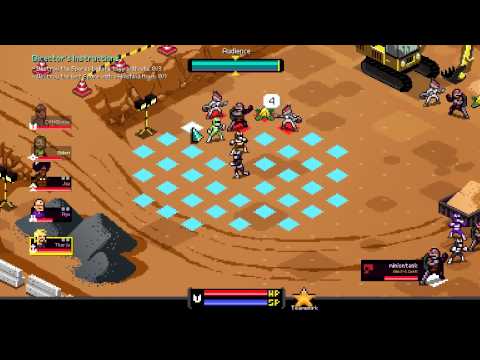
The Game In Question.

Let's examine this with Chroma Squad as a specific example, shall we? The combat, as it stands, does indeed start off fairly simple, without a whole ton of apparent depth. You have five guys who are part of a Sentai studio, Sentai being a term for a specific genre of superhero shows from Japan. They each get two actions a turn, while enemies generally get one unless they can also attack or use a special ability. Those two actions generally consist of a move, followed by one of the following:


  • Move some more.
  • Hit someone.
  • Use a special ability (which often involves hitting someone, but with a weapon.) We'll discuss this more in a bit.
  • TEAMWORK.
That last one is kind of important, because it adds a layer of complexity to the game. See, your normal attacks are pretty damn wimpy. Yes, you hit multiple times, but overall, your average starting dude does around 50 of 90 damage to a mook on an attack. Mileage, obviously, may vary. But with the power of TEAMWORK, you can either add some beef to someone else's attack, allow other people to share your special ability (so long as everyone who supports is touching each other), or give them a little movement boost.

Near the end of a fight from the original Demo.

So, by my count, we have basic mechanics, plus a mechanic that can then change other mechanics. But wait, there's more! See, because Sentai episodes often start with the heroes in their everyday garb, instead of being ULTRA-TEAM or whatever, our characters start that way too, nearly every "Episode". And once they hit a certain number of Fans, they can CHROMATISE (or whatever you've chosen to call it.) What does that do?

First off, it relocates all party members to a certain position (don't ask me how it's worked out, I haven't fully checked, and it's probably subject to change), and it fully heals the party as they're given a second wind by their magical powers. It also boosts their damage on hitting folks, and allows them to use their Special Abilities.

I think we've hit another level of tactical choice here. Because when you Chromatise is an important tactical consideration. On the one hand, you can thin out mooks just fine by using Teamwork, and you can, if you're canny, even damage bosses that way. But you can only get that sweet, sweet full heal once per Episode, and, to make the choice harder, you can't use some of your best attacks (including the Finishing Move) until you've done it. Some Episodes, for extra challenge, don't let you Chromatise at all.

This is already sounding above the depth level for your average Western RPG focused on combat, where, yes, you have more options to start with (Do I use Magic Missile, or Paralyzing Ray, or [goes on for half a minute]...?), but they amount to, in essence, much the same things (Do I do ranged damage? Do I do melee damage? Do I play Rock-Paper-Scissors with Elemental damage?). It even cuts down on options in the game that are objectively less useful than their counterparts with other party members (DnD Psionics, I'm looking at you!)

Remember folks, more choices doesn't necessarily mean extra depth. It's terribly easy to confuse the two, as games have shown in the past. But we then come to a very important question: Even if it were shallow, would it be badly designed?

For the answer to that, let's look at what it's aiming for. Firstly, it's aiming for being fun, as games often do. This is a largely subjective thing, and so we're going to largely skip it. I personally find it fun. Secondly, it's aiming to simulate (to a limited extent) the genre of TV it's based on. So I'll sum up what characterises Sentai, and we'll judge based on that whether it succeeds.
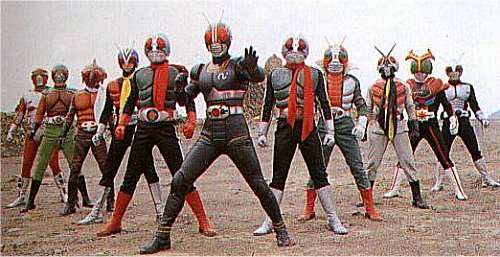
Various incarnations of Kamen Rider. Budget for each costume? Probably around £150, if that.

Sentai Shows Are Often Low Budget

Anyone who's seen Power Rangers has seen one of the higher budget Sentai Shows produced. Especially when they got into movie territory. But most Sentai Shows are not like that. Take a look at Ultraman, or early Kamen Rider. They're low budget as hell. Hell, go look up the Sentai version of Spider-Man, a thing that exists, and both amuses and horrifies me as a Spidey fan.

In Chroma Squad, you start with a budget of $1000. Your first season is mostly filmed on the street, or in warehouses, your costumes are made of buckets, cloth, and hope, and, no joke, one of the studio "upgrades" you can buy is... an SD camera. SD, as in "Standard Definition for the modern day."

There's also a mechanic for recycling your old stuff to craft new stuff, with no guarantee you'll get anything useful out of your old costumes or weapons. And most of your "filler" episodes (which you're contractually obligated to record) won't make you more than around $50. At best.

Yeah, I think it nailed the feel of a low budget studio. And that's without going into the jokes on the subject, like Cardboard Boxer or the girl who doesn't get dialogue, because she wasn't paid for that. That's actually a really common thing in film extra work, as an aside: Talking roles pay more.

Sentai Shows Are Fuelled By Their Fandom

It sounds obvious, but when you factor in that Sentai Shows are often recorded on a stupidly low budget, every fan who might be able to pay you a favour counts, especially in the early days... Especially since those favours might be material for the show, such as access to filming venues. And, in Chroma Squad, your fans count in multiple ways. You can't Chromatise without pleasing fans. You can't earn diddly if you disappoint your fans, and there are emails you'll get from fans that may unlock better gear or certain episodes down the line.

Again, this nails it, as Sentai groups often do live performances, and, like wrestling, it's the Call to the audience that determines what happens.

Amazingly, I couldn't find some cool flips. But trust me, Sentai has them in SPADES.

Sentai Fights Are Flashy, And Often Formulaic

Game design wise, this one seems like a gimme: Strategic RPGs have fixed fights with scripted behaviour that you're meant to exploit to win. But let's look at the formula a little for a standard fight.

  • Mooks ambush our heroes.
  • Fight ensues, and there's a lot of flipping around, positioning, and double-teaming.
  • The heroes discover that there's Too Many, and decide to POWER UP!
  • Mooks (and even the Big Bad) stand back and let this happen (generally, there are exceptions)
  • ASSKICKING TIME.
It's important to note that a Big Bad rarely enters the fray while his mooks are still standing, and if they do, the heroes generally only defend themselves until it's time to power up.

This formula is heavily encouraged in the first Episode, with Fan Requirements. These are essentially little challenges that get you more Fans (and thus more money, gear, and little things you need to craft shit), and, in this case, we have certain challenges for the three Acts of the first Episode (I've been capitalising these, by the way, because they're essentially different names for, in game-design parlance, Levels.)

First act, you have to do three "Team Acrobatics" (use Teamwork to move people further), and all be above 50% health by the end of the fight. So there's your flipping, and the impression that the Mooks are just... Well, Mooks.

The Big Bad of the Season reveals himself (and he is suitably silly), and the Second Act begins. Here, we have to beat four Mooks in one turn, and beat the last with a Finishing Move. Suitably dramatic, but it's important to note two things here: Firstly, the first requirement isn't possible without taking some form of beating, and secondly, the optimal strategy here is to go for one of the corners, lure four guys in, get them down to half health or less, smack 'em down, and the last guy gets lured into the Finisher.

This is often what happens in a Sentai fight.

Finally, we have the Third Act. Cardboard Boxer has entered the scene, surrounded by mooks. But if we want the full Fan Appeal, we have to beat CB with a Finisher, and we mustn't attack him until all the Mooks are gone. Again, it works with the theme, and proves challenging, because Cardboard Boxer isn't restrained by your petty heroic rules, and he hits like a bag of lead bricks.
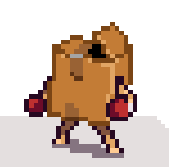
Cardboard Boxer. In all his, er... Glory. Yes, Glory.

From the get go, it's there.

So now we come to the points (for lo, there are multiple) of this post: Firstly, choices do not equal depth, and just because you don't see the depth, doesn't mean it isn't there. More importantly, though, people conflate depth or choices with Good Game Design, and that just isn't true, because choices can balloon out of control and make the game messy, and layers of depth, as we've noticed, don't matter a jot if people don't notice.

No, it's far more important that you do what you set out to do, and keep it fun. Clickr isn't a game with the depth of Age of Wonders 3, but I enjoy both equally, because they're designed around their main themes and mechanics. So far, Chroma Squad is doing what it set out to do. It's by no means fully balanced yet, or easy enough for the newbie to get it on their first try (Speaking of: PUT YOUR TUTORIAL BACK IN, BEHOLD STUDIOS, REGARDS, A. GAMER), but, at least so far, it looks to be tightly designed around its theme, and that puts it in my Good Books for now.

Monday, 2 June 2014

Game Things That Make Me Rage: Story, And When NOT To Use It.

Okay, so recently, I've been playing a few "Casual" games. Things like Tales of the Orient: The Rising Sun, that sort of thing. And it's pissing me off. Why is it pissing me off? Because they don't think the game is good enough. That is, of course, a subjective opinion, but it's hard to get rid of when there's a lot of unnecessary shite around what is, essentially, a Match-3-Or-More game (the -Or-More comes from one of its mechanics).

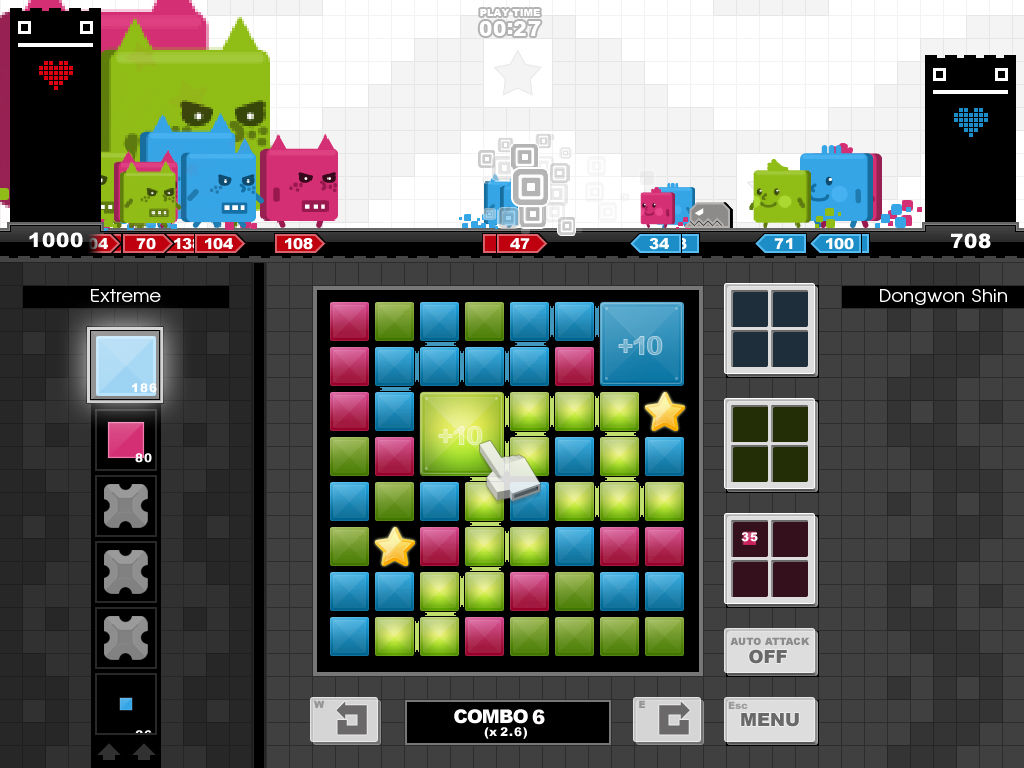
This is the game...

The game itself is, as mentioned, a Match-3 game. Or rather, three different styles of Match-3 in one game, because you can pick to play any level with one of the main three types of match-gaming mechanics: Click a cluster to get rid of tiles, click two clusters, swap 'em, and maybe get rid of two sets of tiles in one go, and drawing a line from one matching tile to another through matching tiles to get rid of tiles. It's a game about getting rid of tiles, and our lizard brain is fine with that.

What our lizard brain is not fine with, however, is annoying pop-ups with story that I don't care about, and my hindbrain definitely doesn't give a shit about (no boobs, no compulsive behaviour, no fine asses... Nope, moving on!)

...And this is your reward (sans annoying pop-ups), as shown to you by a player who is better than you will ever be.

Essentially, there is this city that got destroyed, and a bunch of refugees, including three chucklefucks who are going to be giving you annoying popups for most of the game, want to rebuild elsewhere and be safe and yada-yada-yada. No really, all I hear past that point is a combination of endless chatter and "YOU MUST CONSTRUCT ADDITIONAL PYLONS", because that's essentially all the story boils down to. You click tiles to build up the refugee city, and you are going to be faced with a screen that shows how your village is progressing, complete with stylised people, with the occasional pop-up saying "Oh my, this thing is important for our village because reasons, you have to build it [which will take a longer number of harder levels the further you are in the game]"

It's a waste of good art resources. Why?

Because nobody wants to be told to continue the game. And while it may seem to the developers that they were rewarding the player, they really aren't. Because it's the wrong damn game for it. And because it's not actually a story, it's a framework that's been shoved into the role of story. Fuck. That.

See, even most of the nerds are happy!


Now let's look at Girls Like Robots. Surprise surprise, it's a casual-ish puzzle game. But the story isn't based on telling you what reward you have to get next, it is the reward. And it's pretty gosh-darned cute, too. I won't spoil it for you, but it's silly, it's romantic, and good fun. And guess what, it doesn't tell you you have to continue. I mean, look at that screenshot, and tell me you don't want to see more smiles (or angry faces, if that's your thing!)

Battle mode never looked so CUUUUUUUTE!

Or why don't we go the other way, and look at, say, Circuits, or Clickr? Neither of those have a story, and I love them both. Not because of their nonexistent story, but because their art styles work, they have fair to good mechanics, and there's no damn popups telling you you *have* to finish this level or the people you don't care about won't thrive. Oh, and the music helps too.

And guess what, Green Sauce? One's cheaper, one's the same price, and one's only a quid more expensive.

I've found exactly the same thing with racing games. Blur wanted me to care about a plot from some random Need For Speed game, while having substandard netcode, a flawed matchmaking system, and track design that allowed one player to DNF everyone else if he was halfway good and got to a nitro first on at least three of the tracks. Pyroblazer wanted me to care about its Post-Human Space Opera, but neglected the fact that a game where a mechanic becomes mandatory isn't nearly as fun as a mechanic that lets you be a pro if you learn it. Meanwhile, Wipeout let the backstory be there for anyone who wanted to find it, and Burnout Paradise largely didn't give a fuck about story, preferring that you just roam around a city blowing shit up.

So here's some protips for devs:

- Story is a reward, a spice. It isn't something you try to shovel.
- Story can be ignored if you have everything else right, in most varieties of games.
- Make sure everything else works, and if you're going to have a story, that it fits somehow. That last one really trips a lot of people up, and is the core of what I'm bitching about here.

Saturday, 3 May 2014

Game Things That Make Me Rage Part 1: Hidden Object Madness

There are some spoilers in this post for games you probably shouldn't play if you value your sanity. So, if you're the type of person who actually enjoys this sort of thing, don't read this post, because I'm going to be spoiling something you might actually buy. And I'm not sorry at all for that.

Having been a game reviewer (and technically still being one... It's like being a book critic, you just can't let go of basic skills), there are things that really piss me off, and are guaranteed to have me pan your product. In this post of unwieldy titles, and the ones like it, I'm going to be talking about some of them, and we're going to begin with something that I have a love-hate relationship with. Mostly masochistic hate.

There is an entire genre of games that dare call themselves Adventure Games. They are not adventure games. No. They're Lovecraftian abominations of bad writing, shitty puzzles, and a level of effort best described as "ADHD Stoner who's forgotten what the fuck he was doing."

They are... Hidden Object Puzzle Adventure Games. And I can even recite a fucking checklist that a hell of a lot of them fill. So let's go through it, shall we?

Many of them contain some hackneyed supernatural threat

I'm looking at my "collection" (mostly gotten from Indie Bundles, GG sales, and the poor fools at Cateia who sent me two in a row, despite my reviews), and over two thirds of them involve either demons, witchcraft, psychic powers, ghosts, or a combination of the above. It's enough to make anyone who has even a vague background of occult research weep. This wouldn't be so bad if it weren't for the second point.

The writing is moment-to-moment drama, with little to no consideration of overarching plot or sense.

Right, let's start pulling examples out here.


This is The Gift, by Alawar Games. I somehow managed to get what I'm assuming is a third to halfway through before quitting for health reasons (Apoplexy is bad for you, mmmkay?), and part of the reason is that bad writing offends me. Amusing, considering I am told I have a somewhat loose grasp of grammar. But grammar is one thing. Random for the sake of drama is another.

The game begins, sensibly enough, in an alternate 1930s style setting, where our southern belle on the cover, a disgraced occult detective, is called to investigate a murder that may be (is) related to a closed case involving ritual murders by spell. Okay, I can deal with tha-

Oh, wait. a vision from the murder scene leads us to a witch's occult store, who then grabs us and gives us another vision of another place, and somehow it turns out that our ex-partner is involved, along with some dude called Riker who we appear to have no reason to care about, and then it turns out someone in our circle was meant to meet the witch in the diner, and somewhere along the way we got actual magic powers instead of some fucked up version of psychometry, and then it turns out that the serial murder is actually going to kill usssss allllllll, starting with a small child who is the next target because oh-look-we're-pulling-your-heartstrings. Oh, and your partner is suddenly missing around the same time.

Did I mention that this oh-so-scary malevolent force is called... Wait for it... Suspense! The Nothingman.

Even writing that down made me clutch my head in psychosomatic pain. Now, let's look at another example of the genre from another company. Nightmares From The Deep: The Cursed Heart.

This one isn't so much an offender because the plot beats are nonsensical (although they are), but because everyone is a fucking idiot. Let's use the beginning of this "masterwork" to illustrate this point.

Okay, so our main character is a museum curator, who wants to hold an exhibition based on a pirate that's cursed or somesuch. She even manages to get the pirate's body, and his supposedly magical kit that he got in a deal with a demon (see? Ghosts and Demons!). Naturally, she wants to display the pirate with his gear, because a pirate without gear isn't half as awesome. So far, so good.

But the first time she puts one of these artefacts on the pirate, the room starts shuddering and he glows with what I'm sure the creators felt was an "eldritch light". Let's leave the graphics out of this, though, and continue on our theme. Okay, that's weird, but once isn't really a pattern, right?

If you guessed, from that last sentence, that she does this twice more (Rule of Three is, by the way, an important thing in gaming), that the second time has more effects (that she rationalises away), and then, in what is actually a mildly spooky display, all the lights tinkle and break, spooky things happen, and her reaction is...

"Oh, the lights went out, how odd, I'm sure this has nothing to do with the cursed items that have incredibly obvious and dramatic foreshadowing that is apparent to anyone with working sensory apparatus!"

Her sister, by the way, is also at the museum, because family are cool. Unfortunately, in this game, family are not cool, because her sister is afraid of the dark, and the main character's reaction to this revelation? "Nope, need the torch for fixing the fuse. Nope, can't come with, you stay by this dead pirate who might not actually be so dead anymore, but what would I know, I'm a Clueless Protagonist (TM)"

I think you can guess what happens next, at least in general terms. If you can't, then I'm sure this game will suit you down to the ground, along with the joys of removing fleas from your troop-mates and flinging poop.

The Main Mechanic... And Infinite Monkeys.

Okay, so there are two main mechanics to these games. One of them is the standard adventure game "Use object on other object to progress story or remove an obstacle in some fashion", with all the joys and problems therein. This, surprisingly, is not the problem, as many of the solutions are common sense. Not all of them, just many, and frankly, I'm thankful the proportion is that high.

The other mechanic, however, induces fits of rage in me that would surprise many of my close friends. You see, the other main mechanic is the wonderful idea of "Find hidden objects in among a bunch of junk to progress the story... somehow."

Let's go back to The Gift for this one.


Okay. So this one, if I recall, has at least a modicum of sense behind its general placement (being in a home somewhere). But you will find very similar scenes that you have to play through for your reward of more game in the unlikeliest fucking places. An altar. A beach. An alleyway where fuckdammit I've already been here (more on that later). But there are things this screenshot is not telling you. For example, guess how many of these objects you get to keep for solving actual puzzles? At most, three. And most of the time, it's just one. Usually the hardest fucking one to find.

Then there is the fact that the writers often just fling darts at a dictionary, then the artists shrug and draw whatever the fuck comes to mind with that word. In another game by the same company, you have to find a pole-axe. As in a polearm. As in a very long stick with a sharp thing on the end. There is no such thing in among the random junk. But hiding on a tree branch is a bog-standard axe. This is what you're looking for.

You'd think, what with the hiding things to break up their visual profile (a common dirty trick in these games), colouring them exactly the same as their surroundings (a very dirty trick in these games), and literally hiding things inside other things with no hint that they're there (Oh, hi, Cateia!), that the litany of stupid wouldn't end there. But no, even in the HOPA games where you aren't somehow involved with the supernatural, you have a magical ability. It's a magical ability that all HOPA protagonists have: The ability to peel fucking graffiti, etchings, scratches or paintings from a wall, and say "Yup, that was the thing I was looking for, yessiree bob". Sometimes, these are the actual puzzle items for the more traditional adventuring portions. This wouldn't be so bad, if it weren't for the other sins these things pull.

Where am I meant to g- THE FU? THAT WASN'T THERE BEFORE!

Backtracking is a Bad Thing. Most games, nowadays, appreciate this. HOPAs mostly don't. The Gift is an excellent example of this, because, on the flimsiest of contexts, it will send you somewhere you're pretty sure was only a single-puzzle room, where, all of sudden, there will be a pile of garbage you've never seen before, or a thing you just thought was graphical flavour has magically turned into a garbage pile or puzzle. The alleyway in The Gift is definitely the worst offender here... The pile of garbage that you have to sort through has a fucking trolley in it. Guess what you definitely can't see in the alley before you find the general area has changed your context sensitive pointer to "GARBAGE TIME, BIZHATCH!"

Some games in this genre will throw you a bone. Shadows: Price For Our Sins , for example, has an actual map, which also shows whether there's shit to do in a location or not. But most of the time, though, you are reliant on the hint function. Which, once it has led you to the actual puzzle, will shut down for anything up to 10 minutes, depending on difficulty settings. By the way, this is the same hint button that shows you where that one fucking object you can't find because the artist was too creative with the skew function in Photoshop is.

Now, this wouldn't be so bad, if it weren't for the fact that most first time players will buy into the whole "ERMAHGERD, TIME LIMIT" thing that all these oh-so-dramatic stories have (The Gift: NOTHINGMAN IS GOING TO KILL EEEEEEEVERYBODEEEEE. Shadows: MY FRIENDS ARE STUCK IN HEELLLLLL. Nightmares from the Deep: MY SISTER GOT KIDNAPPED BY A GHOST PIRATE WHO'S GOING TO SACRIFICE HER TO GET HIS WIFE BACK...).

It becomes a lot less dramatic when you realise how utterly prepared the entire world is to fuck you over, though. Which leads nicely onto my final point.

A World of Puzzle Locks


Puzzles in adventure games, hell, even in roleplaying games, are a wonderful idea when done right. Oh look, the evil Lord Fzqefwuk was a joker, wasn't he? We have to solve this word-play riddle before we're all mashed into pulp! Seriously, a good puzzle or riddle can actually buy a GM time, and still be entertaining. It's cool.

But there is such a thing as "too much of a good thing", and HOPA slamdunks that principle, along with other useful ones like "common sense" or "sanity". I don't remember the pictured puzzle, it's probably from further along in The Gift than I got. But if you thought Resident Evil was bad for puzzle locks and fucking weird shaped keys, you ain't seen nothin' til' you've seen a HOPA! Lemme pull an excerpt from my review of "Where Angels Cry", by Cateia Games. 

"Play towers of Hanoi... again. Rotate pictures to get 1 sixteenth of the items you need to finish the act. Look for other hidden items (angel statues) for dubious achievement awards. While you're at it, why not wince at some truly terrible voice acting (It's-a-me, italiano-stereotype-ah!), and wonder at how these monks (who are obviously involved in some conspiracy, because DRAMA!) ever get any work done."

To get two rooms in one direction, I seem to recall needing something like twelve red and blue gems, a Towers of Hanoi puzzle, some tile puzzle I brute forced, a colour matching puzzle I brute forced, and about six hidden object minigames. The monks, meanwhile, have obviously memorised the puzzles, and have gems coming out the fucking wazoo, for they are freely able to move around. And no, the puzzles don't follow any sort of difficulty curve, why would you think that? You're just as likely to find that one annoying "shuffle shit around till it's right" puzzle near the end of the game as you are the "glorified jigsaw."

In Summary (or perhaps In Memoriam)

Hidden Object Puzzle Adventures are evil. But I keep playing them in the misguided hope I'll find a few that aren't terrible, and because, as much as they are a dark stain against everything that is good in game design, they still fondle our lizard brain enough that the masochism continues. Now, if you'll excuse me, I have to go to the kitchen and make a nice calming cup of tea...

...Now where did I put my lizard crest, twelve blue beads, and solution to the crossword on the kitchen door?